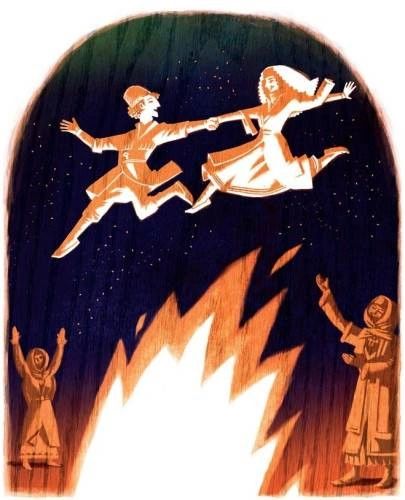
As couples around the world prepare their roses and chocolates for Valentine's Day, Armenia and its diaspora prepare matches and bonfires for the eve of the 14th, Tiarnundaraj. Mainly held for couples, participants line up to hold hands and jump over fire, a joyful act blessing their relationship with love, strength, and harmony. The ritual is also believed to bring prosperity and fertility, now with additional religious significance in the community.
Historical versus Modern-Day Significance
Commonly referred to as Trndez, meaning "coming to meet the Lord," the tradition stems from pre-Christian ancient Armenian history and focused on purification. It was eventually integrated into religious practice by the Armenian Apostolic Church, officially celebrated as the 40-day mark since the birth of Christ (the other January 6) on the evening of the 13th into the 14th. Churchgoers joyfully sing and dance around a bonfire in the courtyards, bonding over the fire's light and warmth on a winter's night.
As modern-day Armenians cope with cultural discrimination and mass displacement, the fire is a glimmer of hope for the population's future—hope for renewal, continuity, and preservation—something the community is familiar with as it continues to bravely adapt to targeted aggression without wavering. Flames light up the memory of genocide survival, exile, and growing statelessness—spanning from the atrocities committed by the Ottoman Empire during WWI, mass exodus of Nagorno-Karabakh in 2023, Azerbaijani invasion the following year, and more. The burning light also signifies resistance to the death of Armenian traditions, which clearly cannot be killed or conquered. The holiday's beautiful contrast of integrating heritage with modern traditions is a reminder of the population's ancient evolution into the first Christian nation, and a nod toward future adaptation to conserve its lineage.
Diaspora
Trndez is celebrated in the same way among the Armenian diaspora as those still living in the homeland. It beautifully connects millions of Armenians around the world and serves as a cultural anchor for second and third-generation immigrants who may feel less connected to their roots while away from home. Something as small as lighting a fire with fellow Armenians can be seen as a powerful act of preservation in any assimilation-heavy environment. Preservation can be impossible if cultural traditions like this are not held, or are overwhelmed by the pressures of integration into new habitats after migration.
Rooted in Past and Future
Practicing Trndez is more than a performance, it's honoring the Armenian culture and its continuation. This weekend should not be about the Instagram stories or other social media aesthetics documenting the scenes, but about cementing the memory of why this ritual exists. Participating with the intention of cultivating a culture of practice in our community should be at the forefront as a way to ensure Armenian existence for another thousand years, and beyond.
With respect to Valentine's Day, Trndez is more than a holiday for couples—it models cultural resilience that's rooted, flexible, and communal. The holy fire doubling as both nostalgic and forward-looking was likely intentional, inspiring sentiments of responsibility and positivity for future generations to thrive on. This weekend, let's all carry the fire in our cultural education, language, families, and local communities.
So when you gather around the bonfires with your loved ones this year, remember that the tradition of Trndez has evolved along with our families' ancient histories as a firm promise—we are still here, and we intend to remain.